No items found.
When it comes to Legionella risk assessments, how often you need them can vary. In its Approved Code of Practice (ACOP) L8, the Health and Safety Executive (HSE) states that “You need to review the [Legionella risk] assessment regularly and specifically when there is reason to believe that the original risk assessment may no longer be valid.”
How often ‘regularly’ is may vary depending on the specific nature of your premises. In this guide, we are going to help you determine your Legionella risk assessment frequency based on your circumstances and what you need to do to stay compliant.
Read on to learn more, or to speak directly to a water hygiene expert, call us now on 0800 358 110.
So, how often should a Legionella risk assessment be reviewed? As mentioned, ACOP L8 states that Legionella risk assessments should be reviewed ‘regularly’ or after any changes to the water system. It does not, however, give set timeframes for how often ‘regularly’ might be. You can find more information about ACOP L8 in our guide.
‘Regularly’ might vary based on your water system and how it is used. Your risk assessment will be unique, and should serve as a representation of how your individual system works. For example, more complex water networks or systems that are more likely to produce water vapour, such as spas and showers, will need to have their risk assessments reviewed at a higher frequency. Additionally, premises with higher occupant numbers or larger numbers of vulnerable occupants, such as healthcare facilities or care homes, will also need to review their Legionella risk assessments more often.
When discussing Legionella risk assessments, it is also important to discuss the difference between reviewing and reassessing.
Reviewing a risk assessment involves simply checking that the current assessment still matches the water system, including layout and usage, and that the control measures are still relevant.
Reassessing is the process of completely renewing the risk assessment, typically following changes to the water system, how it is used or if there is reason to believe that the current control scheme is ineffective.
Generally, a Legionella risk assessment should be reviewed more frequently than it needs to be reassessed. However, the specific intervals for these procedures will vary based on your individual system and risk assessment.
The requirement to control the growth of Legionella bacteria in water systems is laid out in a series of legislation and regulations, including:
The best way to ensure compliance with all of these is to adhere to the guidance given in ACOP L8. ACOP is not legally binding, but it is accepted by the HSE and other regulatory bodies as sufficient to demonstrate compliance with the law.
As we have covered, when it comes to Legionella risk assessment, how often they need to be conducted varies based on the site and how it’s used. But risk assessments are just one part of Legionella control.
To be compliant, you must also:
Details of how to prevent Legionella growth in water systems are laid out in HSG274.
A Legionella Awareness Certificate will typically last between two and three years, depending on the provider. Even if your certificate does not have an expiration date, it is still recommended that you renew it every two to three years. However, it is also worth noting the most important factor in Legionella competence is how often a person applies and updates their understanding. Someone who is less involved in Legionella control on a day-to-day basis will likely need to refresh their certification more often to stay up to date.
How often a Legionella risk assessment will need to be renewed will be based on the specific premises, but the two events that trigger the requirement for a new assessment are:
According to ACOP L8, “The duty holder must ensure that the person who carries out the risk assessment and provides advice on prevention and control of exposure must be competent to do so.”
In short, it is advisable to contract a qualified Legionella risk assessment provider such as EMS Water.
At EMS Water, we offer Legionella risk assessments across the UK, including in Manchester, Shropshire and Liverpool. We have offices in Hereford, Worcester, London and Cardiff, giving us nationwide coverage. Wherever you are in the UK, we can help.
We work with clients from all sectors, but some of the most common include hospitals, care homes, schools and offices. Regardless of what sector you operate in, we can adapt our services to suit.
EMS Water offers a range of water hygiene services, including:
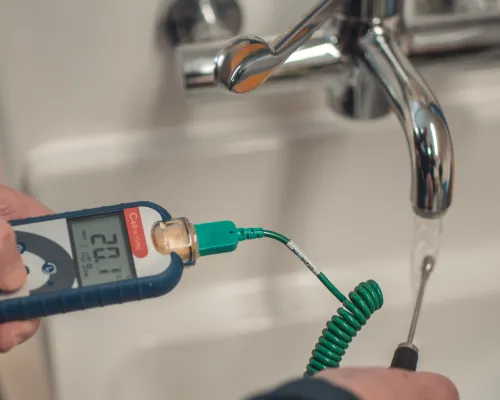
L8 temperature monitoring services
Legionella disinfection services
For a complete solution to your water hygiene compliance, from risk assessments to monitoring, trust EMS. To discuss our services, call us now on 0800 358 110, email us at info@emswater.co.uk or fill out our contact form.