No items found.
Expansion vessels are a critical part of any pressurised water system, both hot and cold. However, without proper care, they can also present ideal growth conditions for harmful bacteria, including Legionella. Preventing this means regularly contracting expansion vessel flushing services.
In this complete guide, we’re going to cover everything from what expansion vessels are to the legal requirements for flushing and maintaining them. Keep reading to learn more, or to speak directly to an expert, just give us a call now on 0800 358 1100.
Through the use of expansion vessels, pressure in hot and cold water systems can be effectively and safely regulated. They include a flexible internal membrane or diaphragm, which accommodates fluctuations in system pressure. This prevents pressure changes from causing damage to rigid components and protects the system from long-term harm.
There are three main types of expansion vessels. All are comprised of a pressurised tank with a flexible inner membrane, and it’s this membrane that varies by type:
Each achieves the same effect but through varying methods, and there are unique Legionella risk levels associated with them:
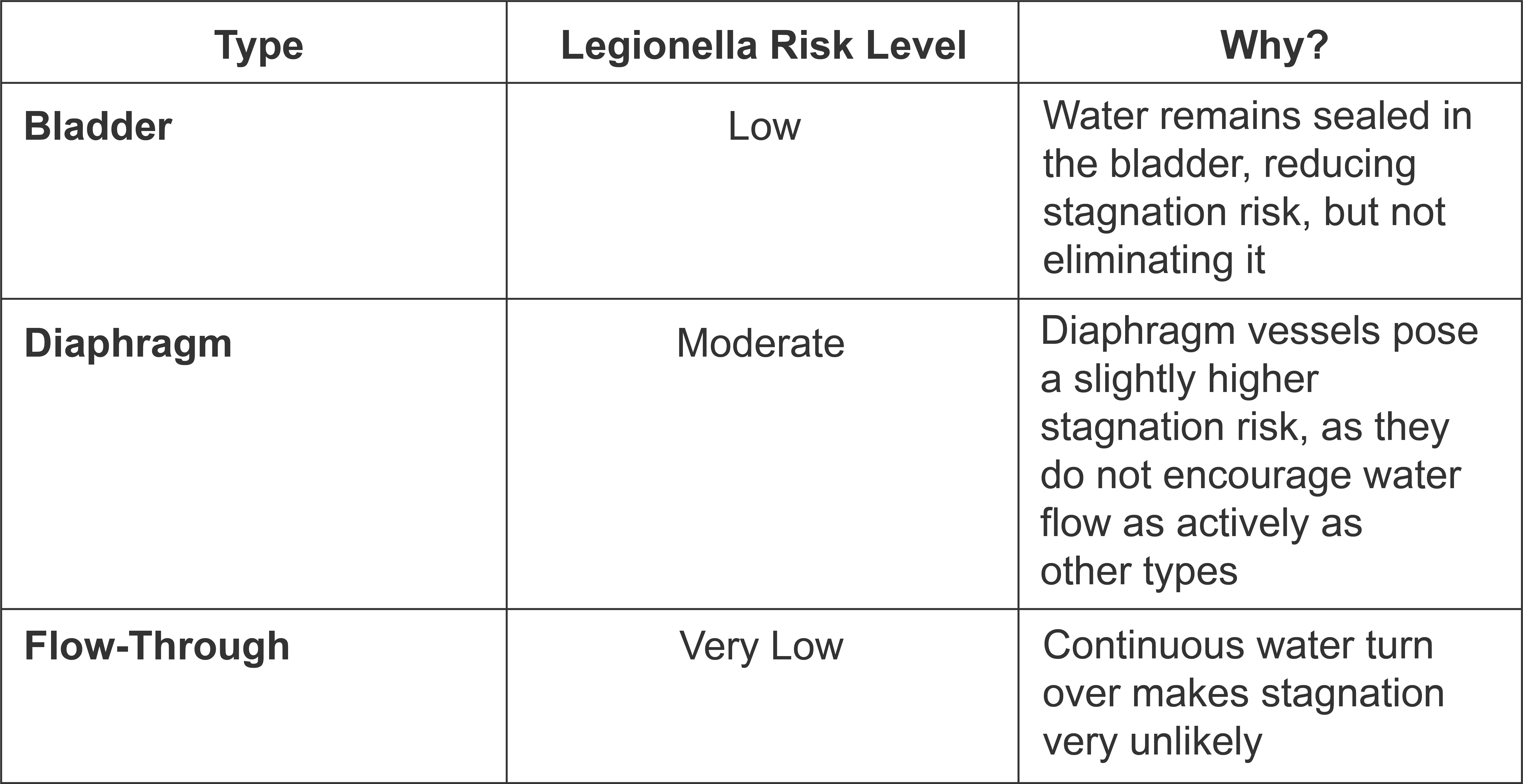
Legionella bacteria grows in water that stagnates at temperatures between 20℃ and 45℃. A well-installed, properly maintained expansion vessel should not provide areas for water to stagnate. However, it can be hard to entirely prevent it, especially with certain vessel types such as bladder or diaphragm.
When water circulation within an expansion vessel is reduced, water can stagnate, creating ideal growth conditions for Legionella. The rubber membranes in some vessels can even provide the bacteria with some of the vital nutrients they need to grow.
Expansion vessel flushing helps prevent the growth of Legionella bacteria. Flushing essentially involves purging and cleaning the inside of the vessel. This removes any stagnating water, as well as any developing biofilms or bacterial growth.
Expansion vessel risks are typically most common on older water systems, where the vessel types are perhaps less efficient or system pressure is less consistent. The risks presented by Legionella growth are also heightened in specific environments such as healthcare or educational settings. Younger, older or health-compromised building occupants are more susceptible to the hazards posed by Legionella bacteria.
Some of the most regular areas for heightened expansion vessel-related risks include healthcare facilities, care homes, older offices and commercial properties and educational premises.
Expansion vessels are prone to a number of common failure points, which can increase the risk of Legionella growth:
As the duty holder, or appointed responsible person, for a premises, you are legally required to manage Legionella-related risks in your water system. This includes contracting regular expansion vessel flushing. Your legal responsibilities are set out in legislation including the Health and Safety at Work Act and regulations such as The Control of Substances Hazardous to Health Regulations (COSHH), The Management of Health and Safety at Work Regulations and The Reporting of Injuries, Diseases and Dangerous Occurrences Regulations (RIDDOR).
Guidance for complying with your legal requirements can be found in crucial documents, including ACOP L8 and HSG274. These provide practical steps for ensuring compliance as well as how to reduce the hazards presented by Legionella bacteria in water systems.
Initially, you will be required to conduct a Legionella risk assessment for your water system. This will help inform the creation of a Legionella control scheme, which will be tailored to your individual water system and include information about how frequently your expansion vessels should be flushed. How often your vessels need to be flushed will depend on your specific system and premises type.
Some properties, such as healthcare facilities and care homes, where there are vulnerable occupants, may require more frequent flushing procedures in accordance with HTM 04-01 guidance.
Expansion vessels, like any water system component, have the potential to harbour Legionella bacteria if they are not regularly maintained and flushed. In some cases, expansion vessels can present a particular Legionella risk if they allow for the stagnation of water. This tends to occur where the vessels are older, not properly installed or are oversized in relation to the water system. Regular inspection and flushing help keep risks to a minimum.
Yes. The required frequency for expansion vessel flushing at any given property will be dictated by the system design, expansion vessel type and placement. Some vessel designs are more prone to Legionella growth than others, so may require flushing more often to maintain system safety. By contrast, some designs, such as flow-through vessels, are less likely to experience Legionella growth, so may not require flushing as often.
All expansion vessels will need flushing in order to reduce the risk of Legionella growth. The only variable is how often a particular vessel will need to be flushed. This will be determined as part of your control scheme.
Absolutely. Expansion vessels will need to be inspected and evaluated as part of a thorough Legionella risk assessment, along with the rest of the water system at your property.
At EMS Water, we are a turnkey water hygiene consultancy, offering a complete range of water hygiene services, including:
Whatever assistance or guidance you need to maintain water hygiene compliance, we can help. Just call our team now on 0800 358 1100, email us at info@emswater.co.uk or fill out our contact form.