No items found.
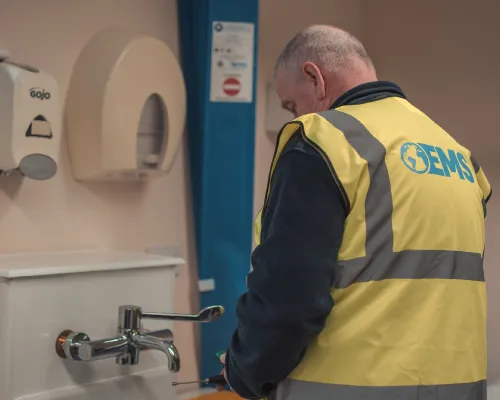
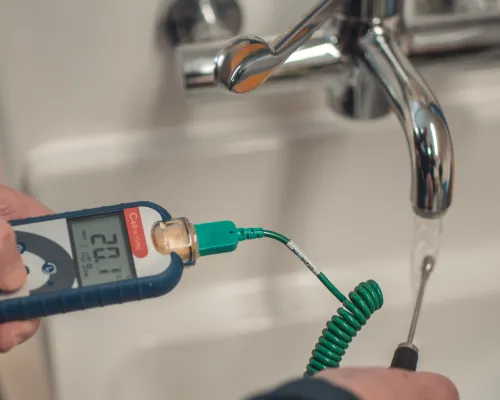
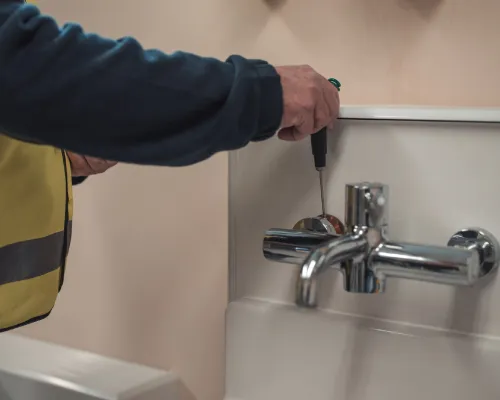
TMV servicing and testing is the disassembly, cleaning and general maintenance of thermostatic mixing valves (TMVs). With regard to Legionella compliance, the intention is to prevent Legionella growth in or around TMVs.
According to HSG274, TMV maintenance should be carried out ‘Annually or on a frequency defined by the risk assessment’. In essence, how often your TMVs need to be serviced will be defined by the outcome of your Legionella risk assessment.
The frequency will depend on factors including the design of your water system as well as what your building is used for and whether you have vulnerable occupants. For example, a hospital or care home will often require more frequent thermostatic mixing valve servicing.
Healthcare settings are often occupied by people who are vulnerable or have already compromised immune systems. As a result, TMV servicing will need to be carried out more frequently compared to other settings, in order to protect people’s health. Organising TMV maintenance is the responsibility of the dutyholder which, in a healthcare setting, is usually the NHS Trust board of directors.
Much like healthcare settings, care homes will require more frequent TMV servicing than other environments. This is because care homes house residents who are more vulnerable to diseases such as Legionnaires’ disease, which is caused by Legionella bacteria. Legionella can grow in or around poorly maintained TMVs. In a care home, the dutyholder, and therefore the person or body responsible for arranging TMV servicing, is the care home operator, provider or owner.
Schools, like any other non-domestic property, will require routine TMV servicing. Although, as before, the exact frequency required will be indicated in your Legionella risk assessment. In a school, the dutyholder responsible for arranging TMV servicing will depend on the type of school:
TMV maintenance is a crucial part of Legionella compliance, but what are the current TMV servicing requirements? To meet legal requirements laid out in the Health and Safety at Work Act and the Control of Substances Hazardous to Health Regulations (COSHH), it is important that dutyholders follow the guidance given in ACOP L8 and HSG274.
As we have stated, HSG274 suggests that TMV servicing should be carried out annually or as required by the risk assessment. So, the first step is to arrange a Legionella risk assessment. The findings of the risk assessment will serve as a guide to how often you should have your TMVs maintained.
TMVs can fail for a range of reasons, almost all of which can be avoided or made less likely with routine servicing and maintenance. Some common causes include:
If TMVs are not regularly serviced in accordance with the recommendations made in your Legionella risk assessment, three main problems can occur:
The simplest way to ensure compliance and maintain your TMVs is to work with a reliable water hygiene consultancy. At EMS Water, we offer complete support with all your water hygiene requirements, from BS 8580-1:2019-compliant Legionella risk assessments to TMV servicing, expansion vessel flushing and more.
We have offices across England and Wales, and serve the whole of the UK offering water testing from South Wales to Manchester. We employ an expert team of technicians and provide everything you need to stay compliant and meet your obligations as a dutyholder.
For friendly support, call us now on 0800 358 1100, email us at info@emswater.co.uk or fill out our contact form.