No items found.
Legionella sampling is a testing measure used primarily where Legionella control measures are suspected to have failed. Accurate Legionella testing is critical, because if a water system contains Legionella, it needs to be treated urgently to avoid harm to occupants as well as significant compliance issues.
Poor sampling can lead to inaccurate results and the potential transmission of Legionnaires' disease. It can also place you in breach of legislation and regulations including the Health and Safety at Work Act and the Control of Substances Hazardous to Health Regulations (COSHH).
In this guide, our experienced team covers when to test water for Legionella, how to choose the right testing locations, the equipment needed, what happens after testing and how to find a qualified Legionella sampling provider. Keep reading to learn more or, to speak directly to an expert, call us now on 0800 358 1100.
Legionella sampling is typically required in one of two circumstances, including where existing control measures are suspected to be failing or where your control scheme requires them, as recommended during your Legionella risk assessment.
If your existing Legionella control measures are suspected to be failing, water sampling for Legionella can help determine whether Legionella is present. This can be the case if an occupant of your building has contracted Legionnaires' disease.
You may also need routine sampling for Legionella bacteria in your water system if your risk assessment identifies the need to do so. This is usually the case if you have vulnerable occupants such as in a care home or hospital, or if your water system is considered to be higher risk for Legionella growth.
The exact locations within your water system that are likely to be selected for Legionella testing will vary depending on the specifics of your system. They will be chosen based on how likely they are to foster Legionella growth. For example, if an area has lower water flow or is consistently at temperatures between 20℃ and 45℃, then it may need testing for Legionella.
Legionella sampling locations should be selected using a risk-based approach, taking into account the findings of the Legionella risk assessment, system design, usage patterns and any previous monitoring results. Common sampling points may include:
Sampling should be undertaken in line with recognised guidance, including HSG274 Part 2 and BS 7592 (Sampling for Legionella bacteria in water systems – Code of practice).
In order to test water for Legionella, you will need a specific set of equipment. Each item is necessary to ensure safe, accurate sample collection and testing.
Safe and correct Legionella sampling is critical to protect testing personnel and building occupants and to ensure accurate results. It is also necessary to maintain compliance with legislation as well as HSE guidance such as HSG274 and ACOP L8.
01 - Plan Sampling Points
Before you start, the first step is to identify appropriate representative sampling locations throughout your water system. This can include taps, shower heads, storage tanks and calorifiers.
02 - Prepare Sample Containers
Next, you should prepare your sterile sample containers. These must contain sodium thiosulphate to neutralise disinfectants and should be labelled with the sample location, date, time, system type and whether the sample is pre- or post-flush.
03 - Take Your Samples
Most samples taken should be pre-flush, which means collecting water straight from the sample point without running any water first. This ensures the sample is representative of the condition of the water at the point of use. You may also choose to take post-flush samples to assess the condition of the wider system.
04 - Record Site Conditions
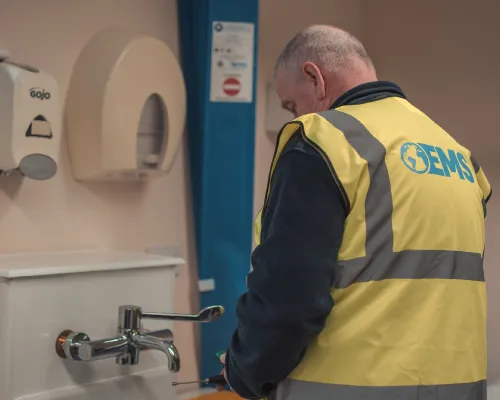
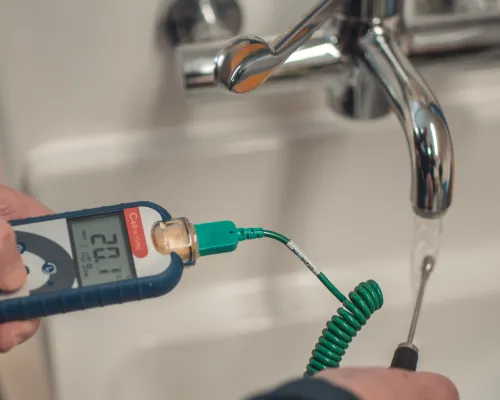
While collecting your samples, you should also make a note of the general site conditions. This includes the water temperature, disinfectant levels, outlet condition as well as any visible scale, debris or stagnation.
05 - Send Samples for Analysis
Once your samples are collected and the site conditions are recorded, you will need to send your samples for analysis at a UKAS-accredited laboratory. They will need to be kept cool and protected from sunlight and must be delivered within 24 hours.
06 - Review Results
The results will need to be interpreted by ‘a suitably experienced and competent person’, as per the HSE’s recommendation. The findings should also be used to inform the Legionella control scheme moving forward, and a record of the results should be kept in your Legionella logbook.
There is a range of ways to test water for Legionella, depending on the specific outlet in question as well as your water system and control scheme. Understanding the best methods for different situations and how to properly conduct them requires a good deal of experience and training.
To ensure safe, accurate sample collection, most dutyholders choose to hire expert water hygiene consultants. This helps them maintain compliance as well as peace of mind.
There are two kinds of samples when it comes to Legionella testing: pre-flush and post-flush.
Pre-flush samples are collected before any water is drawn from the sample location. This ensures the sample reflects normal usage, and would be the water an occupant would use if they were to simply open the outlet.
Post-flush samples are taken after water has been run through the outlet. These samples give a representation of the condition of the wider water system. Each sample type has its own use, and it is not uncommon to collect both.
Accurate sampling for Legionella bacteria in water systems is critical, both for compliance and for occupant wellbeing. There are a number of mistakes that can reduce the accuracy of your sampling, and should be avoided at all costs. These include:
The process of Legionella sampling does not end when the samples are collected. There are several steps that take place afterwards, which are just as important as the samples themselves.
01 - Legionella Sampling and Analysis
Once your samples are collected, they will be delivered to a UKAS-accredited laboratory within 24 hours. There, they will be analysed by trained personnel who will deliver precise results.
02 - Interpreting the Results
After you have received your results, the next step is to interpret them. The HSE advises that this should be carried out by a ‘suitably experienced and competent person’. This usually means a trusted water testing services provider.
03 - Legionella Logbook Documentation
The results of your Legionella testing will need to be recorded in your Legionella logbook. Your Legionella control scheme should also be adjusted as necessary if the results indicate that your current control scheme is ineffective.
The best way to ensure accurate, HSG274-compliant Legionella sampling is to work with a proven water hygiene consultancy such as EMS Water. We have been providing expert water sampling for Legionella for years, with locations across the UK including in Hereford, Worcester, London and Cardiff.
We employ highly skilled specialists and work with a trusted network of UKAS-accredited laboratories. For everything from sample collection to logbook support, EMS Water can help.
To learn more or book your Legionella sampling, reach out to our friendly team today by calling 0800 358 1100, emailing info@emswater.co.uk or filling out our contact form.