Shower Head Cleaning for Legionella Explained

> Make an Enquiry

Shower heads are a potential growth area for Legionella bacteria, especially when they are not often used or are cleaned infrequently. Because shower heads generate fine aerosols, they can present a significant route of exposure if Legionella is present in the water system. As a result, regular Legionella shower head cleaning is necessary to ensure building occupant safety and compliance with legislation including the Health and Safety at Work Act as well as guidance such as HSG274 and ACOP L8

In this guide, our expert team explains why shower head cleaning for Legionella is necessary, how often it needs to be carried out, the signs your shower heads need cleaning and how to clean a shower head for Legionella compliance.

Read on to learn more or, to speak with an expert, just call us now on 0800 358 1100

Why Are Shower Heads a Legionella Risk? 

Shower heads are a Legionella risk for a few reasons: 

  • Legionella-friendly temperatures - when shower heads and associated pipework are infrequently used, water can stagnate and remain within the temperature range of 20°C to 45°C, creating conditions that can support the growth of Legionella
  • Limescale buildup - without regular cleaning, shower heads can accumulate limescale and other materials, which harbour Legionella 
  • Aerosol production - when a shower is used, it generates fine water droplets (aerosols). If the water contains Legionella, these aerosols can be inhaled, making shower heads one of the most significant potential routes of exposure 

What Does HSG274 Say About Shower Head Cleaning? 

HSG274 provides practical guidance from the HSE on controlling the risks associated with Legionella in water systems and supports dutyholders in meeting their legal responsibilities under ACOP L8 and wider health and safety legislation. 

For infrequently used outlets, including shower heads, HSG274 recommends that appropriate flushing regimes are implemented to minimise stagnation and maintain control of the Legionella risk. The frequency of flushing should be determined based on the findings of the risk assessment and the characteristics of the water system.

Additionally, it suggests that Legionella shower head disinfection and cleaning should be carried out ‘Quarterly or as indicated by the rate of fouling or other risk factors, e.g. areas with high risk patients’. 

The shower head should be taken apart and all parts thoroughly cleaned before reassembly. This is to remove any limescale and other debris which could encourage the growth of Legionella. 

What Happens if Shower Heads Are Not Cleaned Properly? 

Without regular cleaning, shower heads can accumulate limescale, mould and other debris or contamination. These buildups can encourage the growth of Legionella bacteria or even, in the case of mould, present their own risk factors. 

As the dutyholder of a non-domestic property, you are legally required to assess and control the risk of Legionella within your water system, including in shower heads. Failing to conduct regular shower head cleaning for Legionella can constitute non-compliance. 

Signs a Shower Head Needs Cleaning or Descaling 

To maintain compliance with HSG274 guidance, your shower heads will need cleaning at least once a quarter or ‘as indicated by the rate of fouling’. However, there are a few signs that you may need to increase the frequency of your Legionella shower head cleaning, including: 

  • Reduced water pressure - deposits in or around the shower head can reduce water pressure, restricting flow 
  • Uneven spray pattern - blocked holes in the shower head can cause water to spray unevenly or at odd angles 
  • Discoloured deposits - white, brown or orange deposits around the shower head can be caused by mineral buildups 
  • Dripping after use - dripping after the shower head is used can indicate trapped limescale within the head 
  • Visible limescale - visible limescale buildup on the shower head is a clear sign that it needs cleaning 

How to Clean a Shower Head for Legionella Compliance 

The best way to ensure legal compliance and keep your shower heads Legionella-free, especially in larger properties or sites with vulnerable occupants, is to arrange for regular professional Legionella shower head cleaning. However, for smaller properties or more routine cleaning, you can follow the simple steps below. 

How to descale shower heads: 

  1. Detach the shower head and dismantle any parts that can be taken apart 
  2. Place all the components into a bucket or plastic bag filled with a mild acid like vinegar
  3. Leave to soak until the scale dissolves or as recommended by the manufacturer  
  4. Scrub the shower head or components to remove any debris and rinse thoroughly in clean water
  5. Reassemble and reattach the shower head 
  6. Flush the shower head with water 

DIY cleaning can help with general maintenance, but it is always advisable to book professional shower head cleaning for Legionella compliance and occupant safety. 

Shower Head Cleaning as Part of a Legionella Control Programme 

Shower head cleaning is just one part of an effective Legionella control programme. Most non-domestic properties will require a range of control measures depending on the exact features of your water system: 

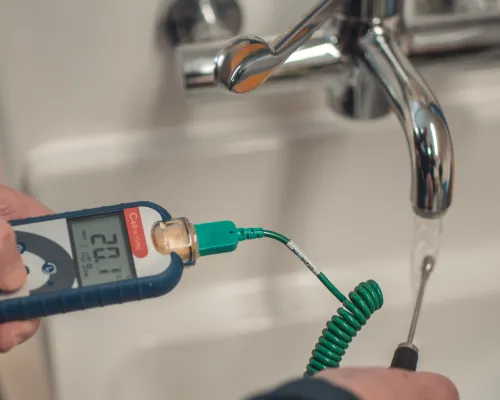
  • Temperature monitoring - regular temperature monitoring at key points throughout your water system ensures that water is not sat for long periods at temperatures that are likely to encourage Legionella growth 
  • TMV servicing - thermostatic mixing valves (TMVs) need regular inspection, cleaning and maintenance to prevent Legionella growth and avoid scalding 
  • Expansion vessel flushing - expansion vessels require routine flushing and cleaning to remove debris and ensure water circulation 
  • Water tank inspections - water tanks can proliferate Legionella bacteria growth unless they are regularly inspected and maintained as needed 
  • Legionella risk assessments - thorough risk assessments are critical for maintaining compliance, providing a framework for your control measures 

Choose a Water Hygiene Specialist for Shower Head Cleaning 

The best way to ensure legal compliance and occupant safety when it comes to Legionella shower head cleaning and Legionella control in general is to work with a trusted water hygiene partner

At EMS Water, we provide expert water hygiene compliance support, including Legionella shower head disinfection, for dutyholders across the UK. From risk assessments to storage tank inspections and more, our expert team can help with all aspects of your water hygiene and Legionella control scheme.
EMS Water Swimming Pool Picture
EMS Water London Picture
EMS Water Legionella Picture
EMS Water Shower Picture
EMS Water Town Picture
EMS Water Water Management Picture

FAQs About Cleaning Shower Heads for Legionella Control

How often should shower heads be cleaned under HSG274?

HSG274 indicates that Legionella shower head cleaning should be carried out at least quarterly or ‘as indicated by the rate of fouling or other risk factors’. Other risk factors can include the presence of vulnerable occupants, such as in a care home, hospital or school. The ideal shower head cleaning routine for your site will be highlighted in your Legionella control scheme, which in turn is advised by your Legionella risk assessment.

What is the difference between cleaning and descaling?

Shower head descaling is specifically the process of removing limescale buildup, usually caused by hard water. Shower head cleaning is a more general process, where the shower head is cleaned of all dirt, debris and buildup which could encourage the growth of Legionella bacteria.

Can shower head cleaning be completed in-house?

While it is possible to complete shower head cleaning in-house, it is always advisable to hire professional water hygiene support such as EMS Water. This is the best way to ensure legal compliance and to maintain occupant safety.