No items found.
Testing water for Legionella involves more than checking its temperature. While temperature monitoring can show whether important control measures are working, detecting Legionella bacteria requires representative water samples to be collected and analysed in a laboratory.
The process starts by deciding whether sampling is appropriate and where samples should be taken. Samples then need to be collected correctly, analysed by a suitable laboratory and interpreted in the context of the water system and its risk assessment.
Speak to a Legionella Specialist
There is no single sampling plan that is suitable for every building. The water system, existing controls and reason for testing all influence where samples should be collected and how the findings should be interpreted.
Before taking samples, it is important to understand the water system and why testing is being carried out. An existing Legionella risk assessment, system schematic and monitoring records can provide useful information about areas where control may be less reliable.
Sampling points should be chosen to provide a representative picture of the system. Depending on the circumstances, sampling points could include hot and cold outlets, areas with poor temperature control, infrequently used outlets or sections where stagnation is suspected.
For premises in Great Britain, Health and Safety Executive guidance for hot and cold water systems explains how system complexity, control performance, low use and stagnation should inform sampling decisions.
The exact sample location should be recorded so that the result can be interpreted correctly and, where necessary, compared with future samples.
Where Legionella sampling is appropriate, the sampling method should follow British Standard BS 7592:2022.
Samples need to be collected using suitable containers and clearly labelled with information such as the location and whether they were collected before or after flushing, where relevant. Where a biocide is present, it should be neutralised where possible so that it does not continue acting on the sample after collection and affect the result. This approach is also set out in the Health and Safety Executive guidance on Legionella testing and monitoring.
Correct handling matters after the sample has been taken as well. Samples should be transported to the laboratory promptly and in suitable conditions.
For the result to be meaningful, the sample should accurately represent the water at the location being investigated. Poor sampling technique, unclear records or unsuitable handling can make the laboratory result harder to interpret.
The Health and Safety Executive guidance on Legionella testing and monitoring states that water samples should be tested by a UKAS-accredited laboratory participating in an appropriate water microbiology proficiency testing scheme.
Culture-based laboratory analysis is commonly used to detect and quantify viable Legionella bacteria in water samples. Unlike a rapid test, culture analysis is not immediate because the laboratory needs time to process and incubate the sample before reporting the result.
Other methods, including polymerase chain reaction testing and some rapid testing technologies, can have specific applications. They should not, however, be treated as automatically interchangeable with appropriate accredited laboratory analysis. The right method will depend on why testing is being carried out and how the result will be used.
A Legionella test result should never be considered in isolation.
The significance of a result depends on factors including the type of water system, where the sample was collected, the concentration detected, how many samples were positive and the people who may be exposed. Existing temperature records, the risk assessment and other control measures also provide important context.
HSG274 technical guidance from the Health and Safety Executive sets out actions for different types of water system and sampling results. An elevated result may require further investigation, a review of the risk assessment and control measures, resampling or remedial action.
Where appropriate, our Legionella disinfection services can support the response to identified problems within a water system.
Routine Legionella sampling is not required for every hot and cold water system.
According to the Health and Safety Executive guidance on testing and monitoring water systems, routine microbiological monitoring is not normally required for standard hot and cold water systems where controls are working effectively. Sampling may become appropriate where there is doubt about the effectiveness of the control regime or where recommended temperatures, disinfectant concentrations or other control measures are not being achieved consistently.
Testing may also be appropriate where:
Other water systems have different monitoring requirements. Cooling towers and evaporative condensers are covered by HSG274 Part 1, while spa pools are covered separately by HSG282. Each system has its own microbiological monitoring requirements.
Sampling should therefore be based on the water system and its risks, not treated as a standard test required at the same frequency for every site.
Water samples can be collected by an operator as well as by an external water hygiene specialist, provided that the person carrying out the work is appropriately trained and properly supervised. This is confirmed in the Health and Safety Executive guidance on Legionella testing and monitoring.
The difficulty with do-it-yourself testing is not simply collecting water in a bottle. Selecting meaningful sampling locations, following the correct method, handling the sample properly and understanding the result all require appropriate knowledge.
Rapid-result or self-test kits can appear to offer a straightforward answer, but their role is different from professional sampling followed by appropriate laboratory analysis. A result also needs to be considered alongside the condition of the system, monitoring data and the Legionella risk assessment.
In Great Britain, using an external contractor does not remove the dutyholder’s responsibility for managing Legionella risk. The Approved Code of Practice L8 and related Health and Safety Executive guidance on managing Legionella risk make clear that competent external support can be used while responsibility for appropriate management remains with the dutyholder.
No. Temperature monitoring and Legionella sampling measure different things.
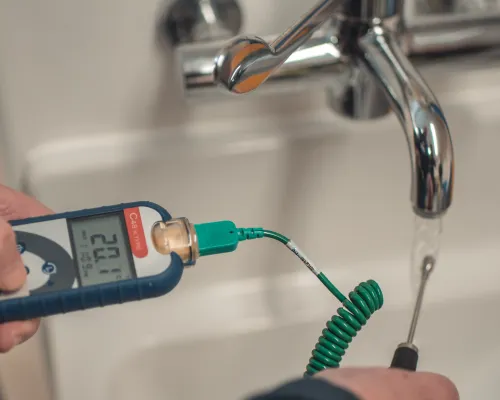
Water temperature monitoring checks whether the water system is operating within important control parameters. Where temperature is used as the primary control measure, HSG274 Part 2 guidance for hot and cold water systems provides technical guidance on monitoring and managing those systems.
A Legionella sample is different because it is analysed for the presence of the bacteria themselves.
This distinction also matters when interpreting a negative Legionella result. A sample represents the water collected from a particular location at a particular time. It does not replace ongoing temperature monitoring, inspection or the other measures identified through the risk assessment.
Good water hygiene management therefore relies on the control regime as a whole, rather than laboratory sampling alone.
When Legionella sampling is needed, we can manage the process from selecting appropriate sampling locations through to interpreting the laboratory findings.
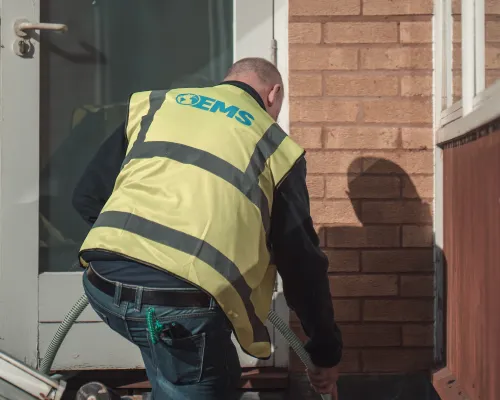
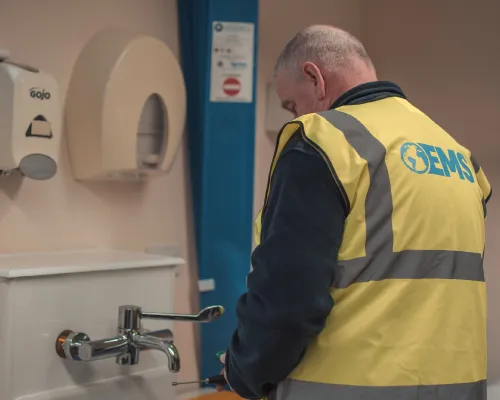
Our trained specialists attend the site, review the relevant system information and collect representative samples in accordance with BS 7592:2022. Samples are then sent to an independent UKAS-accredited laboratory for analysis.
Once the results are available, we interpret them in the context of your water system and risk assessment. If further action is needed, we provide clear recommendations on the appropriate next steps.
Our professional Legionella sampling service is available nationwide, with DBS-checked engineers and direct access to our consultants. Recommendations are based on the individual site and reason for testing.
Enquire About Legionella Sampling
The turnaround depends on the laboratory method and the samples being analysed. Culture-based Legionella testing requires laboratory incubation and is therefore not an instant test. We can advise on the expected laboratory turnaround when arranging your sampling.
There is no single testing frequency for every water system. The Health and Safety Executive guidance on Legionella testing and monitoring states that routine microbiological monitoring is not normally required for standard hot and cold water systems where controls are effective. Other systems can have specific monitoring requirements, so frequency should reflect the system, risk assessment and applicable guidance.
No. A negative result reflects the sample collected from a particular location at that time. It should be considered alongside the risk assessment, temperature monitoring and other control measures set out under the relevant Health and Safety Executive Legionella guidance.
According to the Health and Safety Executive guidance on testing and monitoring Legionella, sampling may be carried out by a service provider or by an operator who is appropriately trained and properly supervised. Whoever takes the sample needs to understand correct sampling procedures, recording and handling so that the result is representative and can be interpreted properly.